Hisense 116Ux Specs, Features, and Value: Is it worth the price tag?
Category: TVs
Introduction
The Hisense 116Ux is one of the most attention-grabbing consumer televisions released in recent years: a 115.5–116 inch class RGB MiniLED 4K set that pushes the boundaries of size, brightness, and local-dimming performance for the living room. For buyers considering a statement-piece TV for a home theater, large living space, or a multi-purpose media room, the 116Ux offers headline specifications that read like a flagship scoreboard — RGB MiniLED array, native 165Hz panel, extensive local dimming, Dolby Vision and HDR10+ support, and a premium audio partnership. This article examines the 116Ux in practical terms: what it actually delivers day-to-day, how well it meets use-case expectations, where it excels and where buyers should temper expectations, and whether its overall value matches the premium it commands.
At a glance: Key specifications
- Screen size: Approximately 115.5–116 inches (diagonal viewable)
- Resolution: 4K UHD (3840 × 2160)
- Panel type: VA with RGB MiniLED backlight
- Backlight: RGB MiniLED local-dimming array (thousands of zones)
- Peak brightness: Manufacturer-rated very high peak (marketing figures up to multiple thousands of nits)
- Color: Wide color gamut (high BT.2020 coverage, Pantone validation claimed)
- Refresh rate: Native 165Hz, VRR-capable (48–165Hz)
- HDR support: Dolby Vision (and Dolby Vision IQ), HDR10, HDR10+, HLG
- Processing: Hi-View AI Engine X
- Smart platform: Google TV (region dependent; some SKU variations use VIDAA)
- Audio: Multi-driver premium sound system with Dolby Atmos support (manufacturer collaboration on high-end audio tuning)
- Gaming: AMD FreeSync Premium Pro, ALLM, low-latency modes, enhanced MEMC
- Design: Ultra-thin bezel, large physical footprint; wall or floor mounting requires professional planning
Detailed product review and analysis
Picture quality and display technology
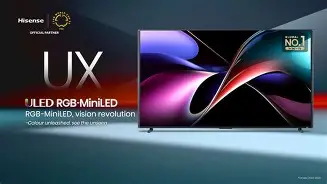
The defining technical differentiator for the 116Ux is the RGB MiniLED backlight. Unlike many MiniLED sets that use white or blue LEDs and rely on color filters, RGB MiniLED uses discrete red, green and blue LEDs for more direct color control at the backlight level. In practical terms, this produces more saturated highlights and improved color fidelity in bright scenes, and it can improve color volume when the display is driven to very high luminance values.
Combined with a very large count of local dimming zones, the 116Ux delivers black-level control and localized contrast that are markedly better than traditional edge-lit LED TVs and make highlights pop without turning entire scenes into halos. The native 165Hz panel gives an advantage for fast motion and gaming scenarios: motion clarity and frame interpolation become smoother, and the panel’s VRR range supports modern consoles and PC graphics cards for tear-free gameplay.
That said, the underlying panel type is VA, which tends to favor high contrast and deep blacks but typically has more limited off-axis viewing than IPS panels. On a display of this size, seating geometry matters: viewers seated far off-center may notice contrast and color shifts. The set's anti-reflection treatments mitigate ambient light reflections, but in very bright living rooms a projector or OLED in darker conditions could still be preferable for cinematic immersion.
HDR performance
For HDR content, the 116Ux checks many boxes. Support for Dolby Vision (and Dolby Vision IQ) and HDR10+ points to a broad compatibility with dynamic metadata formats, and high peak luminance combined with precise local dimming improves specular highlights. For bright, HDR-heavy scenes — action blockbusters, nature documentaries, or sports replays with sparkling light sources — the display can deliver a level of visual “pop” that lower-tier LCDs cannot match.
However, HDR experience is influenced by content mastering and room conditions. The TV’s ability to achieve truly cinematic shadow detail will depend on calibration and viewing distance. Buyers who plan to watch in a dark home theater will benefit most from professional picture calibration; in a bright family room, the set’s anti-reflection and high brightness help maintain perceived contrast.
Gaming and motion handling
Gamers will appreciate the 116Ux’s low input lag modes, ALLM and a wide VRR window, which make it suitable for next-gen consoles and PC gaming. FreeSync Premium Pro compatibility is useful for PC users who want higher refresh rates and adaptive sync. Native 165Hz capability positions this TV as an attractive option for users seeking fluid motion at high frame rates, provided source hardware can drive high-frame gameplay at 4K.
Practical caveats include the physical size and the way multiple viewers in a living room might prefer viewing positions closer to the center — competitive gamers often sit closer to screens; a 116 inch display will require unusually large room layouts to be comfortable for desktop-style gaming. For couch-based console gaming, the sheer immersive scale is a major plus.
Audio and smart features
Hisense pairs the 116Ux with an elevated built-in audio system and audio tuning by a premium partner on some SKUs, and the TV supports Dolby Atmos playback. The built-in speakers can fill large rooms better than typical thin-screen speakers, but buyers who prioritize the absolute best sound will still prefer an external sound system: a dedicated AV receiver, soundbar, or multi-channel speaker setup will deepen the low end and improve spatial accuracy for music and film.
Looking for the best TVs & Home Theater deals on Amazon?
Browse Now →On the smart-TV side, the 116Ux ships with Google TV in many regions, offering a familiar app ecosystem, integrated voice search, and personalized content discovery. In other regions the VIDAA platform may be used — both platforms provide the essentials for streaming, though feature sets and app availability vary slightly by market. For power users the presence of a full-featured smart OS reduces the urgency for external streaming devices.
Design, installation and practical considerations
At roughly 116 inches, the set is a statement object rather than an appliance. Installing it requires careful measurement for wall strength, doorway clearances, and furniture placement. The TV's width and height demand either a very large wall or a custom floor mount. Transport and setup typically exceed the capability of two casual helpers; professional delivery and mounting are recommended and often provided as an optional service from retailers or specialized AV installers.
Serviceability and replacement panels for ultra-large displays can be more complicated and expensive than for mainstream-sized TVs. Warranty coverage and the proximity of manufacturer-authorized service centers should be a consideration for buyers outside major metropolitan areas.
Pros & Cons
Pros
- Exceptional size and immersion — true home theater scale for large rooms
- RGB MiniLED backlight with thousands of local dimming zones for superior highlights and contrast control
- Very high peak brightness for striking HDR highlights
- Wide HDR format support (Dolby Vision, HDR10+, HDR10, HLG)
- Native 165Hz panel and broad VRR support, making it very capable for gaming
- Premium onboard audio options and Dolby Atmos support
- Modern smart-TV platform (Google TV/VIDAA) and voice assistant integration
Cons
- Extremely large footprint — requires a large room, careful seating, and professional installation
- Higher price bracket — premium hardware and size come at significant cost
- VA panel viewing-angle limitations can affect off-axis viewers in wide seating arrangements
- Replacement, service, and moving costs for a 116-inch TV are higher than standard sizes
- Built-in audio is strong for a TV, but serious enthusiasts will still want external speakers
How the 116Ux compares: a simple comparison table
| Hisense 116Ux | Typical 85–100” MiniLED Flagship | 4K Laser Projector (home theater) | |
|---|---|---|---|
| Screen size | ~115.5–116" | 85–100" | Up to 120" (depends on throw and screen) |
| Panel / technology | VA + RGB MiniLED | VA/IPS + MiniLED (white/blue) | No panel (projection); laser light engine |
| Peak brightness | Very high (manufacturer-rated) | High | Moderate-to-high, depends on model and screen gain |
| Local dimming | Thousands of zones (RGB control) | Many zones, but fewer than 116Ux | Not applicable |
| HDR support | Dolby Vision, HDR10, HDR10+, HLG | Dolby Vision or HDR10+ support varies by model | HDR10/HDR10+ support; Dolby Vision varies by projector |
| Gaming | 165Hz, VRR, FreeSync Pro | 120–144Hz common, VRR | Medium; input lag often higher than TVs |
| Installation | High complexity — large, heavy; professional recommended | Moderate — still large but more manageable | Requires screen and precise placement; variable complexity |
| Cost of ownership | High (display price + installation/service) | High–medium | Medium–high (projector + screen + mounting) |
Buying guide: who should consider the Hisense 116Ux?
Buying a 116-inch TV is a decision that stretches beyond typical spec-checking. The product fits a relatively narrow set of buyers and use cases. The following points help to determine whether the 116Ux is a suitable purchase.
1. Room size and viewing distance
Measure the room first. A display this large requires generous viewing distance to avoid visible pixel structure and to allow comfortable head and eye movement. For 4K at 116 inches, a general recommendation is seating distances of 10 feet (3 meters) and beyond for full cinematic comfort; closer distances make the screen feel overwhelming and may reveal scaling artifacts from non-4K sources.
2. Primary use: movies, sports, or gaming?
If the primary goal is immersive movie watching in a large living room, the 116Ux can be transformative — especially for HDR content. For sports and live events it provides an arena-like scale that works well in social rooms. For gaming, the high refresh rate and low-latency features make the TV viable — although competitive gamers who sit much closer to screens may find better ergonomics on smaller monitors.
3. Ambient light and room environment
High peak brightness and an anti-reflective surface help in lit rooms, but truly bright sunlight can still wash out contrast. A controlled lighting environment will yield the best HDR experience.
4. Installation logistics and structural support
Determine if walls, doorways, and staircases permit delivery and installation. Check wall stud placement and the capacity of mounting hardware or consider a dedicated floor-to-ceiling mounting solution. Professional installers are recommended for mounting and calibration.
5. Content sources and AV ecosystem
To get the most from the set, source quality matters. Native 4K HDR streaming services, Ultra HD Blu-ray players, and modern consoles deliver the best results. If the buyer intends to use the TV for broadcast or cable that is not 4K, consider that upscaling is good but not equivalent to native 4K.
Shop the latest TVs & Home Theater picks on Amazon.
See Deals →6. Audio plans
Decide whether the built-in audio is adequate or whether to budget for a dedicated soundbar or full surround system. A separate audio solution will also improve multichannel movie sound and music playback.
7. Warranty, service, and total cost of ownership
Investigate warranty length, what it covers (panel damage, backlight issues), and whether extended warranties or in-home support are available. For very large displays, the logistics and cost of servicing can be non-trivial.
8. Resale and future-proofing
A display of this scale is a long-term investment. Consider the resale market in the buyer’s area; very large TVs are niche and may take longer to re-sell. Evaluate the long-term software support for the TV platform shipped in the buyer’s region.
Real-world use cases and practical notes
Several use scenarios highlight where the 116Ux is likely to shine:
- Home theater in a large space: A dedicated media room or large living room with darkened lighting will maximize HDR impact and create a cinematic feel rivaling smaller commercial screening rooms.
- Shared family viewing and sports: Sports bars of the home — where multiple viewers watch together from various seating positions — benefit from the sheer scale and bright highlights.
- High-end gaming lounge: Casual console co-op or couch gaming with next-gen consoles will be immersive due to size and refresh-rate features.
- Commercial demonstration or lobby use: Large, high-bright displays can act as digital signage or demonstration panels in premium retail or corporate spaces where brightness and clarity are crucial.
Conversely, the 116Ux is less appropriate for small apartments, bedroom TVs, or buyers who primarily watch standard-definition or 720p content without a plan for higher-quality sources. Room layout and viewing angles must also be considered to avoid degraded experiences for off-axis viewers.
Conclusion
The Hisense 116Ux is a bold entry in the consumer TV landscape: it brings RGB MiniLED technology, exceptional local dimming, very high brightness, modern gaming features and an ambitious audio package to an ultra-large 4K canvas. For buyers with the room, budget, and appetite for a statement home theater screen, it delivers a level of spectacle and HDR performance that is difficult to match with smaller TVs.
However, prospective buyers should weigh practical considerations — installation complexity, viewing geometry, content sources, and long-term serviceability — before committing. The 116Ux is most defensible as a purchase when the goal is a long-term, purpose-built entertainment installation where size and picture impact are the priority. In that context, it can be worth the premium; for casual viewers or constrained spaces, a smaller flagship MiniLED or a quality projector system may provide better value and fit.